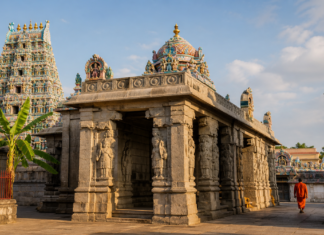


Navagraha Mantra: Meaning, Benefits, and The Ultimate 2026 Pilgrimage Guide
For many families and spiritual seekers in Hyderabad, embarking on a pilgrimage to the ancient planetary shrines in Tamil Nadu is a deeply revered tradition. The roughly 980 km journey down south to the Kumbakonam cluster is not just a travel itinerary; it is a profound spiritual reset. While planetary shrines exist in many local temples, the authentic Navagraha circuit in the Thanjavur and Mayiladuthurai districts holds unparalleled significance for Dosha Pariharam (remedial rituals).
What makes this specific journey so transformative is the power of sound combined with spatial energy. Chanting the specific navgrah mantra while physically standing in the exact shrine dedicated to that planetary deity is considered the ultimate way to appease the grahas. The cosmic vibrations at these millennia-old temples amplify your prayers, making the long journey entirely worth the effort.
Whether you are planning to drive down NH44 with your family or taking the train via Chennai, proper planning is essential. From understanding the meaning of each planetary chant to knowing the latest 2026 highway updates, this comprehensive guide has everything you need to plan a flawless trip to any navagraha temple in the region.
| Detail | Info |
|---|---|
| Best Time to Visit | November to February (20°C to 30°C) |
| Distance from Hyderabad | Approx. 980 km via NH44 and NH38 |
| Primary Hub | Kumbakonam, Tamil Nadu |
| Getting There | Flight to Tiruchirappalli (90 km away) or Train via Chennai |
“Chanting the ancient planetary mantras exactly where the deities reside transforms a simple prayer into a powerful cosmic remedy.”
1. Introduction: The Power of the Navagraha Circuit
The 980 km spiritual journey from Hyderabad to the Kumbakonam cluster takes you deep into the heart of the Chola empire’s architectural and spiritual legacy. While you will find Navagraha shrines tucked into the corners of almost every Shiva temple in India, the Kumbakonam circuit is fundamentally different. Here, each of the nine celestial bodies has a massive, dedicated independent temple—or serves as the presiding deity’s primary cosmic counterpart.
This geographic cluster is considered the most authentic Navagraha circuit in Hindu astronomy and spirituality. Millions of pilgrims travel here annually specifically to perform Pariharam (remedial rituals) to mitigate the adverse effects of planetary transits (Doshas) in their astrological charts.
The ultimate “Why” of this pilgrimage boils down to cosmic resonance. According to ancient texts, physically traveling to these specific energetic centers and chanting the navgrah mantra creates a direct spiritual alignment. It is believed that the deities absorb the vibrations of the mantras more profoundly here, offering unmatched relief from life’s obstacles.
2. Navagraha Mantras: Meaning & Benefits
To maximize the spiritual benefit of your visit, it is highly recommended to chant the respective mantras at each shrine. For the most authentic experience, carry a small booklet of the Navagraha Stotram composed by Adi Shankara. Reading from this traditional text while standing in the temple prakaram is considered highly auspicious.
- Surya (Sun) – Suryanar Koil: “Japa Kusuma Sankasham…” This mantra honors the Sun’s brilliance. Chanting it brings robust health, vitality, and clears obstacles in career and leadership paths.
- Chandra (Moon) – Thingalur: “Dadhi Shankha Tushaarabham…” Dedicated to the Moon, this chant is meant to stabilize emotions. It provides immense mental peace and helps overcome anxiety and stress.
- Angaraka (Mars) – Vaitheeswaran Koil: “Dharani Garbha Sambhutam…” Honoring the warrior planet, this mantra grants courage. It is heavily chanted to resolve crushing financial debts and property disputes.
- Budha (Mercury) – Thiruvenkadu: “Priyangu Kalika Shyaamam…” Dedicated to Mercury, chanting this enhances intellect. It benefits students and professionals seeking sharp communication skills and wisdom.
- Guru (Jupiter) – Alangudi: “Devaanaam Cha Rishinaam Cha…” Revering the cosmic teacher, this mantra brings prosperity. It is chanted for successful marriages, childbirth, and higher education.
- Shukra (Venus) – Kanjanoor: “Hima Kundha Mrinaalaabham…” Focused on Venus, the planet of luxury. Chanting this attracts wealth, artistic success, and marital harmony.
- Shani (Saturn) – Thirunallar: “Neelanjana Samaabhaasam…” The most feared and respected planet. Chanting here mitigates the harsh effects of Sade Sati, teaching discipline and removing deep-rooted karmic obstacles.
- Rahu (North Node) – Thirunageswaram: “Ardha Kaayam Mahaa Veeryam…” This mantra tames the shadow planet. It is chanted to overcome hidden enemies, sudden misfortunes, and snake afflictions (Sarpa Dosha).
- Ketu (South Node) – Keezhaperumpallam: “Palaasha Pushpa Sankaasham…” Revering the planet of liberation. This chant detaches one from worldly sorrows, cures mysterious ailments, and grants spiritual enlightenment.
Pro Tip: What to Pack for the Temples
Carry a physical copy of the Navagraha Stotram, a small reusable water bottle, and a traditional dhoti or dupatta to comply with dress codes. Avoid bringing large leather bags. Amazon India Travel Essentials
3. What’s New: Navagraha Pilgrimage Updates (2026)
The Tamil Nadu government has actively upgraded the infrastructure around the Kumbakonam circuit to handle the massive influx of pilgrims. On March 12, 2026, the Hindu Religious and Charitable Endowments (HR&CE) department officially completed the much-awaited renovation of the outer prakaram at the Suryanar Koil (Sun Temple). As part of this upgrade, new battery-operated cars have been introduced specifically to assist elderly pilgrims around the sprawling temple grounds.
Road connectivity from Hyderabad and Chennai has also seen major improvements. As of May 2026, the expansion of the Kumbakonam-Thanjavur Highway (NH 36) reached 85% completion. This significantly reduces the inter-temple travel time, making it much easier to visit multiple shrines in a single day without enduring severe traffic bottlenecks.
For tech-savvy travelers, a new unified QR-code-based “Navagraha Darshan Pass” was piloted on June 15, 2026. This pass aims to allow faster entry across all nine temples during peak weekends, bypassing the traditional physical ticket lines. Verify latest details at the official website before visiting, as implementation at individual temple counters may still vary.
Latest Updates (2026)
- March 12, 2026: Suryanar Koil outer prakaram renovation completed; battery-operated cars introduced for seniors.
- May 2026: Kumbakonam-Thanjavur Highway (NH 36) expansion is now 85% complete.
- June 15, 2026: Pilot launch of the unified QR-code Navagraha Darshan Pass (approx. status — verify before travel).
4. Upcoming Festivals & Events (Next 6 Months: Aug 2026 – Jan 2027)
Timing your visit alongside traditional Tamil festivals can turn your pilgrimage into a visually stunning cultural experience. However, festival days also mean heavier crowds, so plan your accommodation well in advance. The next six months feature several powerful dates for planetary rituals.
During the Purattasi Saturdays, the crowds at the Shani temple are extraordinary. Thousands gather to participate in the Shani Shanti Parihara chanting. If you wish to check specific crowd management rules for this period, viewing the thirunallar saneeswaran temple timings is crucial for planning your darshan effectively.
Upcoming Festivals & Events (Next 6 Months)
| When | Festival / Event | What Happens |
|---|---|---|
| Aadi (Aug 3, 2026) | Aadi Perukku | Prosperity rituals performed at the Cauvery river banks near the temples. |
| Purattasi (Sept 19 – Oct 17, 2026) | Purattasi Saturdays | Massive crowds at Thirunallar (Shani Temple) for Shani Shanti Parihara chanting. |
| Purattasi (Oct 11 – 19, 2026) | Navratri Utsavam | Special Alankaram (decorations) for the female deities across all nine temples. |
| Aippasi (Nov 15, 2026) | Soorasamharam | Major celebration at Vaitheeswaran Koil (Mars) symbolizing victory of good over evil (date to be confirmed). |
| Karthigai (Nov 23, 2026) | Karthigai Deepam | All temples are beautifully illuminated with thousands of traditional oil lamps. |
| Margazhi (Dec 24, 2026) | Margazhi Arudra Darisanam | Celebration of Shiva’s cosmic dance across the circuit (date to be confirmed). |
| Thai (Jan 22, 2027) | Thai Poosam | Special elaborate processions at Kanjanoor (Venus) and Alangudi (Jupiter). |
Festival dates follow the lunar calendar and can shift. Confirm exact dates on the official temple / HRCE calendar before you travel.
5. Travel Guide: How to Reach from Hyderabad
Reaching the temple cluster from Hyderabad requires a bit of planning since there is no direct, single-mode transport that drops you right at the temple gates. For families who love road trips, driving is a fantastic option. The road route spans approximately 980 km via NH44 and NH38, passing through Kurnool, Anantapur, Bengaluru, and Salem before reaching Kumbakonam. Expect a driving time of 18 to 20 hours, with a one-way toll cost of roughly ₹1,400.
If you prefer the train, you will need to break your journey. There is no direct train from Hyderabad to Kumbakonam. A popular route is taking the Kacheguda–Chengalpattu Express or the Charminar Express to Chennai. From Chennai, you can seamlessly connect to Kumbakonam via the Cholan Express or Mannai Express. You can check exact schedules on the official IRCTC portal.
For those short on time, flying is the fastest approach. You can book a direct flight from Rajiv Gandhi International Airport (HYD) to Tiruchirappalli (TRZ). Kumbakonam is located 90 km from the Trichy airport, which takes about 2.5 hours via a pre-paid taxi.
6. Essential Travel Logistics
The climate in Tamil Nadu dictates the best time for this pilgrimage. The ideal months to visit are from November to February when the winter weather is a pleasant 20°C to 30°C. It is strongly advised to avoid the peak summer months of April to June, where temperatures easily exceed 40°C, making barefoot temple walks incredibly difficult.
Temple timings are strictly adhered to across the state. Most shrines open from 6:00 AM to 12:30 PM and reopen from 4:00 PM to 8:30 PM. Knowing the exact kumbakonam temple timings will save you from waiting outside locked gates in the afternoon heat.
Dress codes are rigorously enforced by temple authorities. Men must wear dhotis or formal trousers—shorts and lungis are strictly prohibited. Women are required to wear a saree, half-saree, or chudidar paired with a dupatta. When booking accommodation, Kumbakonam serves as the perfect central hub, widely known as the temple city of tamilnadu.
Mantra Koodam – CGH Earth
Price: ₹4,500 – ₹8,000/night | Location: Kumbakonam | Best For: Mid-Range Family Stays
A beautiful heritage property offering traditional architecture and highly authentic vegetarian meals. Check latest prices on Agoda
Hotel Raya’s
Price: ₹1,500 – ₹2,500/night | Location: Kumbakonam Town Center | Best For: Budget Travelers
Clean, reliable basic accommodation right in the heart of the town, perfect for quick transit nights. Check latest prices on Agoda
Many temples also feature an “Annadhana Koodam” offering free meals and basic pilgrim rest houses for nominal fees under ₹500. However, these require on-spot booking and offer minimal amenities. Verify latest details at the official website before visiting if you plan to rely on temple accommodations.
7. Pro-Tips for Families
Navigating nine different temples spread across a 60 to 100 km radius requires strategy. While tradition suggests starting at the Suryanar Koil (Sun Temple) and ending at the specific temple governing your astrological dosha, this isn’t always practical. Logistically, mapping a circular route starting and ending in Kumbakonam saves immense time and fatigue, especially for elderly parents.
One expert move is to hire a local driver from Kumbakonam for your entire circuit. Local taxi drivers are intimately familiar with village shortcuts, road conditions, and the exact closing times of each specific shrine. They will ensure you make it to the temples before the afternoon closures.
Each planetary shrine requires a specific offering for pariharam—for example, black sesame seeds for Shani (Saturn) or chana dal for Guru (Jupiter). A common travel hack is to purchase these pariharam items in the Kumbakonam main market rather than at the individual temple gates. Doing so can save you up to 50% on costs (prices subject to change, verify before travel).
- Day 1 — Morning: Start at Suryanar Koil, followed closely by Kanjanoor (Venus) and Vaitheeswaran Koil (Mars).
- Day 1 — Afternoon: Rest at your hotel during the 12:30 PM to 4:00 PM temple closure.
- Day 1 — Evening: Visit Thiruvenkadu (Mercury) and Keezhaperumpallam (Ketu).
| Expense | Budget (INR) | Mid-Range (INR) | Premium (INR) |
|---|---|---|---|
| Highway Toll (One-way) | 1,400 | 1,400 | 1,400 |
| Accommodation (Per Night) | 1,500 – 2,500 | 4,500 – 8,000 | Check current rates |
| Total Base Range | 2,900+ | 5,900+ | Varies |
Safety Tips for Travelers
- Keep footwear securely inside your vehicle, as leaving them outside crowded temple gates often leads to mix-ups.
- Drink only bottled water; the intense heat and changing food routines can upset sensitive stomachs.
- Language can be a barrier as English and Hindi are limited; download a Tamil translator app on your phone.
- Avoid visiting Thirunallar on Saturdays and Vaitheeswaran Koil on Tuesdays if you want to escape severe overcrowding.
- Book special darshan tickets online via the HRCE portal to avoid long queues with touts.
8. Nearby Attractions (Extend Your Trip)
If you are traveling all the way from Hyderabad, it is highly recommended to extend your trip by a day or two to witness the breathtaking Chola architecture nearby.
Nearby Places to Explore
The region around Kumbakonam is home to some of the most magnificent historical structures in India.
- Airavatesvara Temple (Darasuram) — 5 km away — A stunning UNESCO World Heritage site known for its incredibly detailed stone chariot and miniature Chola sculptures.
- Swamimalai Murugan Temple — 8 km away — One of the six sacred abodes (Arupadaiveedu) of Lord Murugan, offering a deeply spiritual and peaceful atmosphere.
- Brihadeeswara Temple (Thanjavur) — 40 km away — The iconic “Big Temple” featuring a massive monolithic Nandi and a towering Vimana that will leave you spellbound.
Reality Check
While the Navagraha circuit is spiritually fulfilling, travelers from metro cities like Hyderabad need to set the right expectations. The sheer volume of crowds, especially on weekends and auspicious Tamil months, can be overwhelming. The temple towns are rural, meaning premium infrastructure, luxury washrooms, and high-end dining are scarce outside of Kumbakonam proper.
Additionally, the language barrier is real. Temple priests and local vendors speak mostly Tamil, and English or Hindi is barely understood in the deeper village shrines. If you are traveling with elderly parents who require constant air-conditioning, strict hygiene, and wheelchair accessibility at all times, this pilgrimage requires meticulous planning and a very patient mindset.
At a Glance: Top 5 Things to Know
-
Hub City
Kumbakonam is your best base for hotels and transport.
-
Midday Closures
Temples are strictly closed between 12:30 PM and 4:00 PM.
-
Strict Dress Code
Men in dhotis/trousers; Women in sarees/chudidars with dupattas.
-
Transport
Hire a local driver to navigate the 60-100 km rural circuit.
-
Mantra Text
Carry the Adi Shankara Navagraha Stotram booklet for chanting.
Location Map
Get Free Travel Tips in Your Inbox
Join fellow Indian travelers who get our best destination guides, budget tips, and hidden spots delivered every week. No spam. Just good travel content.
9. Official Links & Resources
Always verify temple timings, festival dates, and pass systems before starting your long journey. The official portal for the Tamil Nadu Hindu Religious and Charitable Endowments (HR&CE) department is a vital resource for booking darshans: hrce.tn.gov.in.
If you are planning to visit the Shani temple, particularly on a Purattasi Saturday, check crowd updates and specific guidelines at thirunallarshani.org. For general tourism information, heritage site maps, and state-run hotel bookings, visit the official tourism portal at tamilnadutourism.tn.gov.in.
Frequently Asked Questions
What is the correct order to visit Navagraha temples in Kumbakonam?
While tradition recommends starting at Suryanar Koil (Sun) and ending at your specific dosha temple, logistically, a circular route radiating from Kumbakonam town is the most practical way to save time and energy.
Are there direct trains from Hyderabad to Kumbakonam?
No, there are no direct trains. You must take a train like the Charminar Express or Kacheguda-Chengalpattu Express to Chennai, and then board the Cholan Express or Mannai Express to Kumbakonam.
How much is the toll fee for a road trip from Hyderabad to Kumbakonam?
The estimated one-way toll cost via NH44 and NH38 is approximately ₹1,400. Prices are subject to change.
Is there a strict dress code at these temples?
Yes, it is strictly enforced. Men must wear dhotis or formal trousers, and women must wear a saree, half-saree, or chudidar paired with a dupatta.
Which airport is closest to Kumbakonam?
Tiruchirappalli International Airport (TRZ) is the closest, located 90 km away. A pre-paid taxi from the airport to Kumbakonam takes about 2.5 hours.
This post contains affiliate links. If you book through our links, we may earn a small commission at no extra cost to you. This helps us keep travellerkaka.com free for everyone.
Plan Your Trip with Us
Have questions about this destination? We would love to help you plan the perfect trip.
Chat with us on WhatsApp or email us at info@travellerkaka.com