
Kanuma is often spoken about quietly, almost in passing.
Yet, for farming families in Andhra Pradesh, Kanuma is the most heartfelt day of Sankranti.
It doesn’t come with loud celebrations or decorative lights.
It arrives calmly—after the joy of Sankranti—carrying gratitude, respect, and realism.
To truly understand Telugu harvest culture, one must understand what Kanuma festival is and why farmers celebrate it after Sankranti.
What Is Kanuma Festival?
Kanuma is the third day of the Sankranti festival, celebrated mainly in rural Andhra Pradesh and parts of Telangana.
While Bhogi focuses on renewal and Sankranti celebrates harvest and abundance, Kanuma is about acknowledging support systems—especially cattle and agriculture.
It shifts the celebration away from homes and temples to:
- Farms
- Cattle sheds
- Village outskirts
Kanuma reminds people that harvest is not only a human achievement.
Why Kanuma Is Celebrated After Sankranti
Sankranti celebrates success.
Kanuma honours the effort behind that success.
Farmers celebrate Kanuma after Sankranti because harvest gratitude is incomplete without recognising:
- Cattle that ploughed the land
- Nature that supported crops
- Daily labour that sustained farming
Only after thanking the Sun on Sankranti does Kanuma turn attention to the animals and tools that made harvest possible.
This sequence gives Sankranti its balance.
Agricultural Importance of Kanuma
Kanuma is deeply rooted in agriculture.
In villages, cattle are not symbolic—they are essential.
Even today, many farmers depend on bulls and cows for ploughing, transport, and livelihood.
Kanuma acts as:
- A thanksgiving day for farmers
- A reminder of human–nature partnership
- A cultural pause after harvest
That is why Kanuma is rarely observed meaningfully in cities.
Without agriculture, the festival loses its context.
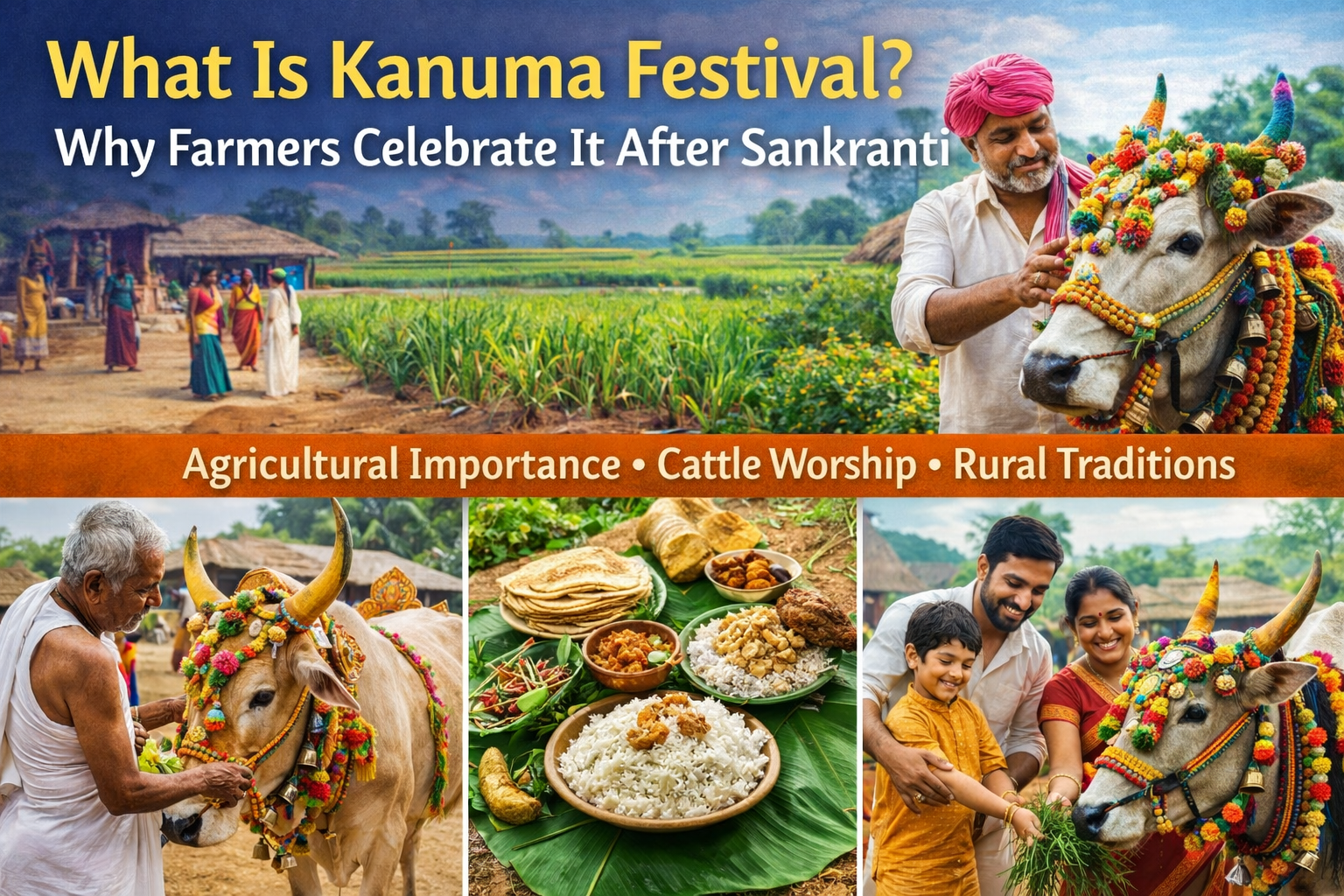
Cattle Worship and Decorations on Kanuma
Kanuma mornings begin at cattle sheds, not inside homes.
Cows and bulls are:
- Bathed early in the day
- Decorated with flowers and cloth
- Marked with turmeric and kumkum
- Fed special food
Children often help elders decorate animals, learning respect through observation.
There is no grand ritual here—only care and familiarity.
The relationship between farmer and cattle is quiet but deeply emotional.
Kanuma Special Foods and Feasting
Kanuma food is different from Sankranti food.
In many regions, Kanuma marks the return of non-vegetarian meals after days of festive cooking. Fresh produce from the harvest is used generously.
Meals are:
- Heavy and nourishing
- Cooked in large quantities
- Shared with neighbours and relatives
Food is eaten together, often outdoors, without hurry.
Kanuma meals are less about variety and more about togetherness.
How Kanuma Differs Across Regions
Kanuma is not celebrated identically everywhere.
In the Godavari belt, Kanuma includes community gatherings and decorated cattle processions.
In Rayalaseema, the festival is simpler and more reflective, closely tied to farming realities.
In coastal regions, Kanuma blends agricultural rituals with local food traditions.
Despite these differences, one thing remains common—respect for cattle and land.
Kanuma adapts to local culture but never loses its purpose.
Kanuma vs City Celebrations
In cities, Kanuma is often:
Skipped
Merged with Sankranti
Reduced to a special meal
Apartment living leaves little room for cattle-based traditions. As a result, many urban families know Kanuma only by name.
This is why understanding village Sankranti celebrations gives a clearer picture of Kanuma’s real meaning.
Why Kanuma Still Matters Today
Modern life celebrates outcomes—results, success, achievement.
Kanuma celebrates effort.
It reminds society that:
- Food does not appear magically
- Nature deserves gratitude
- Animals are partners, not tools
In a rapidly urbanising world, Kanuma quietly preserves agricultural awareness and humility.
Kanuma and the Younger Generation
Many children today celebrate Sankranti without knowing Kanuma.
When children witness Kanuma in villages, they learn:
- Where food truly comes from
- Why animals are respected
- How community life works
These lessons don’t come from textbooks.
They come from lived experience.
Kanuma’s Place in the Sankranti Cycle
Kanuma completes what Bhogi and Sankranti begin.
Bhogi clears the old.
Sankranti celebrates the new.
Kanuma acknowledges the support behind it all.
Without Kanuma, Sankranti becomes incomplete.
That is why elders insist on staying back in villages even after Sankranti day—to observe Kanuma properly.
Final Thoughts: Kanuma Is Gratitude in Action
Kanuma does not ask to be celebrated loudly.
It asks to be understood.
It stands for respect—for animals, land, labour, and tradition.
In Andhra Pradesh villages, this respect is still alive.
If you want to understand Sankranti beyond sweets and holidays, start with Kanuma.
It quietly explains everything.
👉 Explore More on travellerkaka.com
Read our complete guide on the Sankranti festival in Andhra Pradesh, understand Bhogi, Sankranti, Kanuma & Mukkanuma, explore the best villages to experience Sankranti, and plan budget-friendly Sankranti family trips across Andhra Pradesh.