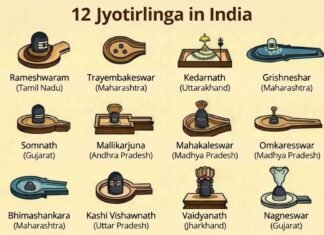

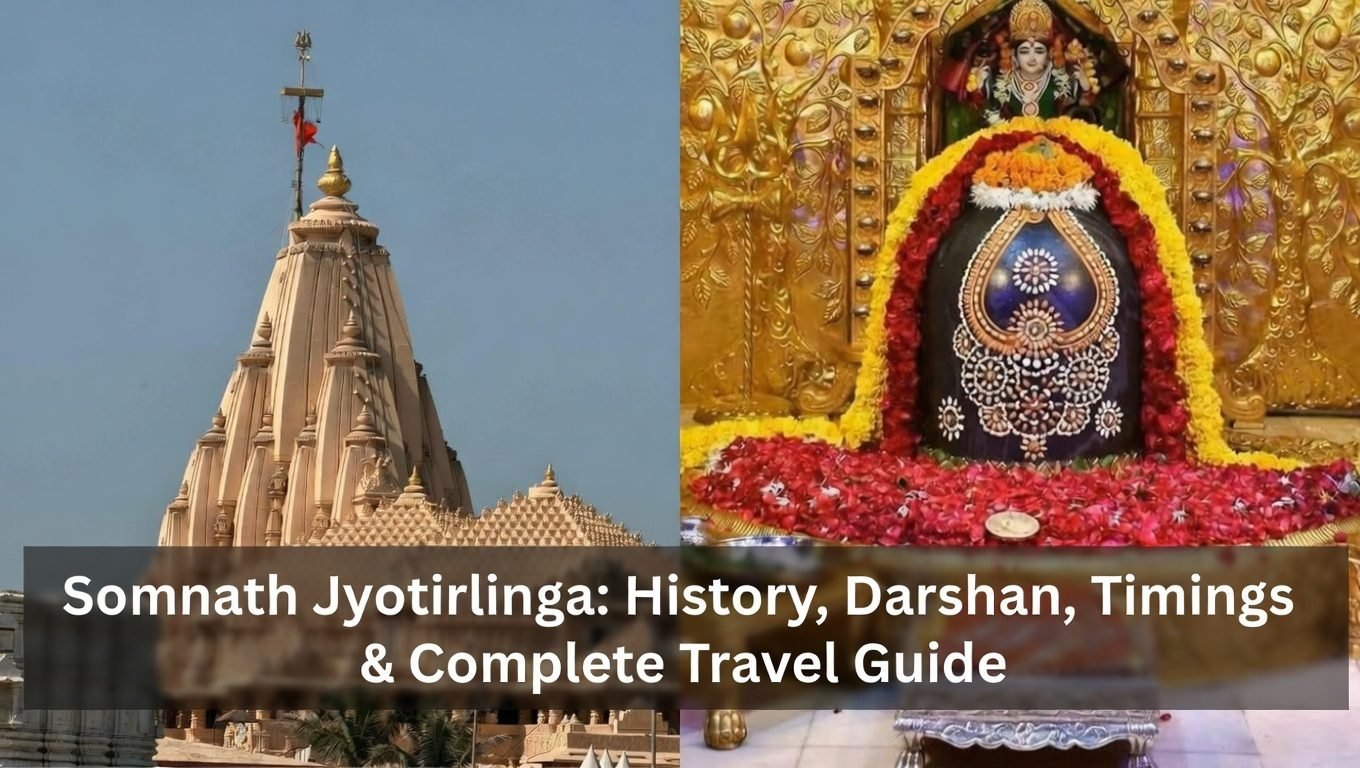
There are temples that are ancient.
There are temples that are powerful.
And then there is Somnath — the first Jyotirlinga, standing on the western shore of India, facing the endless Arabian Sea.
Somnath is not just a temple.
It is a symbol of resilience, faith, destruction, and rebirth.
If you are searching for:
- Somnath Jyotirlinga history
- Why Somnath is the first Jyotirlinga
- Somnath temple timings
- How many times Somnath was destroyed
Somnath Jyotirlinga is the first of the 12 Jyotirlingas in India and one of the most sacred Shiva temples in the country
This is your complete, detailed guide.
Let us begin with quick facts.
Somnath Jyotirlinga – Quick Facts
| Detail | Information |
|---|---|
| Temple Name | Somnath Jyotirlinga |
| Location | Prabhas Patan, Gir Somnath District |
| State | Gujarat |
| Significance | First of the 12 Jyotirlinga |
| Temple Timings | 6:00 AM – 10:00 PM |
| Aarti Timings | 7 AM, 12 PM, 7 PM |
| Light & Sound Show | 8:00 PM – 9:00 PM |
| Nearest Railway Station | Somnath (1–2 km), Veraval (5–7 km) |
| Entry Fee | Free |
| Official Website | somnath.org |
Why Is Somnath Called the First Jyotirlinga?
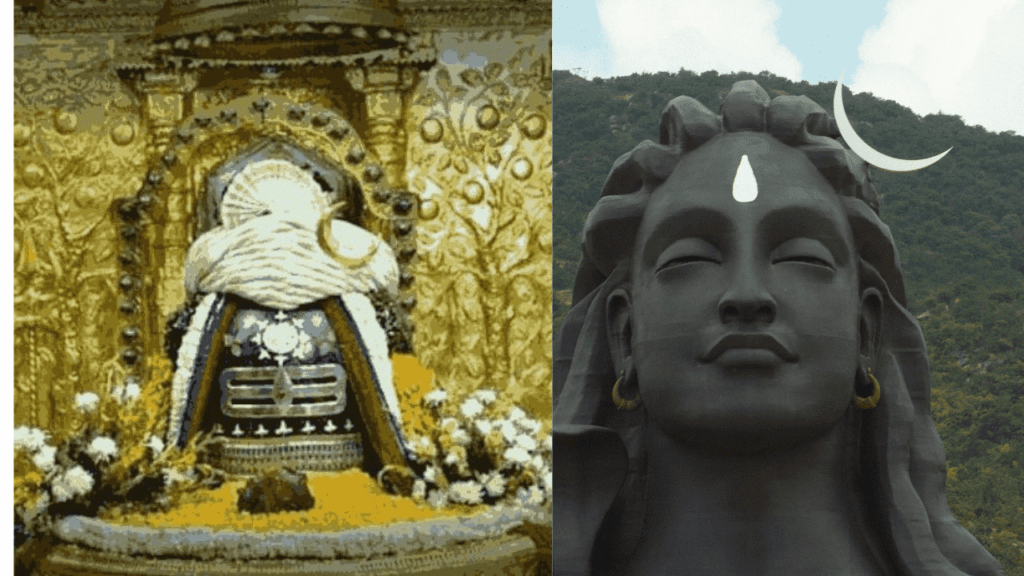
Among the 12 Jyotirlinga in India, Somnath is traditionally listed first.
According to the Shiva Purana, the Moon God (Chandra) married Daksha Prajapati’s 27 daughters but loved only Rohini the most.
Angered by this partiality, Daksha cursed Chandra to lose his brightness.
As the Moon began to fade, he prayed to Lord Shiva at Prabhas Kshetra.
Moved by devotion, Shiva relieved the curse partially and restored his radiance.
In gratitude, Chandra built a golden temple here and installed the first Jyotirlinga.
Thus, this sacred place became known as:
“Somnath” — The Lord of the Moon (Som).
Mythological Significance of Somnath
Somnath represents:
- Renewal after decline
- Light after darkness
- Faith after suffering
The waxing and waning cycle of the Moon is said to symbolize Shiva’s blessing.
Devotees believe:
Praying at Somnath helps restore lost strength — physical, emotional, or spiritual.
This symbolism is why millions visit every year.
How Many Times Was Somnath Destroyed?
This is one of the most searched questions about Somnath.
The temple is believed to have been destroyed and rebuilt multiple times throughout history.
Here is a simplified timeline:
Ancient Era
Original temple believed to be built in gold by Chandra, later reconstructed in silver and wood (mythological tradition).
1025 CE
Mahmud of Ghazni attacked and looted the temple.
12th–15th Century
Repeated invasions and destruction by different rulers.
1706
Temple demolished under Aurangzeb’s reign.
1947–1951 (Modern Reconstruction)
After India’s independence, Sardar Vallabhbhai Patel initiated the reconstruction of Somnath.
The present structure was completed in 1951 in Chalukya architectural style.
The modern temple stands as a powerful symbol of cultural revival.
Architectural Significance
The present Somnath temple is built in Kailash Mahameru Prasad style, inspired by ancient Chalukyan design.
Key architectural highlights:
- Massive shikhara rising over 150 feet
- Intricate stone carvings
- Sea-facing alignment
- Sacred “Baan Stambh” pillar pointing south — symbolizing that no land exists between Somnath and Antarctica in that direction
The temple stands proudly on the shore, where waves constantly echo against its foundation.
The experience of standing at Somnath during sunset is deeply spiritual.
Spiritual Energy of the Location
Unlike many inland temples, Somnath is located directly beside the Arabian Sea.
Devotees believe:
The combination of sea wind, open horizon, and Jyotirlinga energy creates a unique spiritual vibration.
Even those who are not deeply religious feel a powerful presence here.
What Makes Somnath Unique Among 12 Jyotirlinga?
- It is the first Jyotirlinga.
- It represents the Moon’s blessing.
- It symbolizes rebirth after destruction.
- It stands at India’s westernmost spiritual frontier.
- It has survived centuries of invasions.
Somnath is not only a pilgrimage — it is a statement of continuity.
Temple Darshan Timings (Updated 2026)
The Somnath Temple welcomes devotees daily from:
6:00 AM to 10:00 PM
The temple remains open throughout the day, though crowd levels vary significantly by season and festival.
Unlike some Jyotirlinga temples, general darshan here is smooth and well-managed due to structured queue systems.
Entry is completely free for all devotees.
Aarti Timings at Somnath
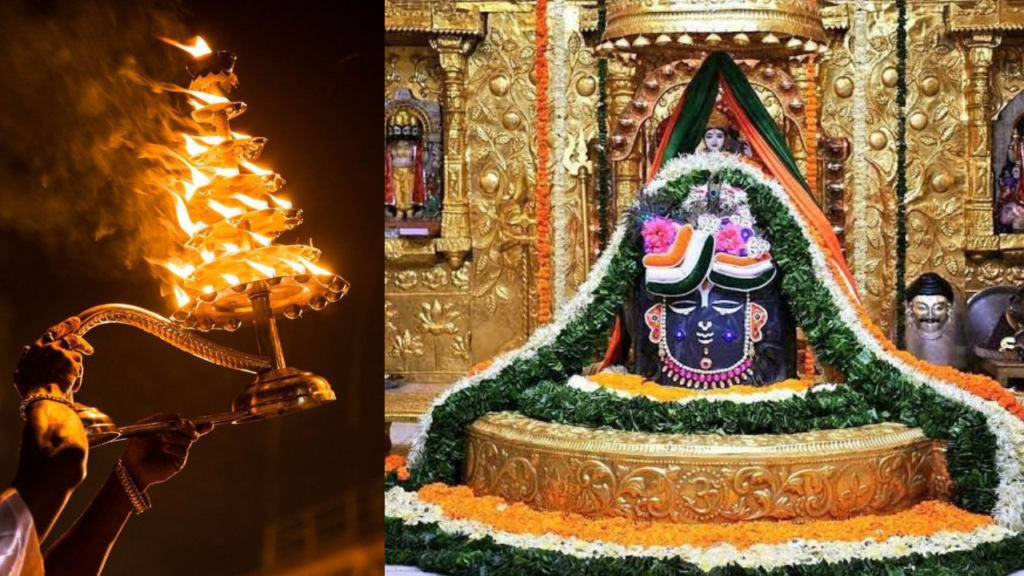
Somnath follows a disciplined daily ritual schedule:
- Morning Aarti: 7:00 AM
- Noon Aarti: 12:00 PM
- Evening Aarti: 7:00 PM
The evening aarti, performed just as the sun sets over the Arabian Sea, is particularly moving.
The sound of conch shells, bells, and Vedic chants merges with ocean waves — creating a deeply immersive spiritual moment.
“If you want to understand the deeper meaning behind Abhishekam rituals performed here, you may also explore our detailed guide on Shiva Abhishekam and its spiritual significance.”
👉 Shiva Abhishekam complete guide
Light & Sound Show – “Jay Somnath”
One of the most unique features of Somnath is its Light & Sound Show.
- Timing: 8:00 PM to 9:00 PM
- Language: Primarily Hindi
- Ticket: Nominal fee (₹25–50 approx.)
The show narrates:
- The mythological origin of Somnath
- The destruction and rebuilding history
- Cultural revival post-independence
The temple façade illuminated at night creates a powerful visual experience.
For travelers who combine devotion with heritage exploration, this is a must-watch.
Temple Architecture & Layout Experience
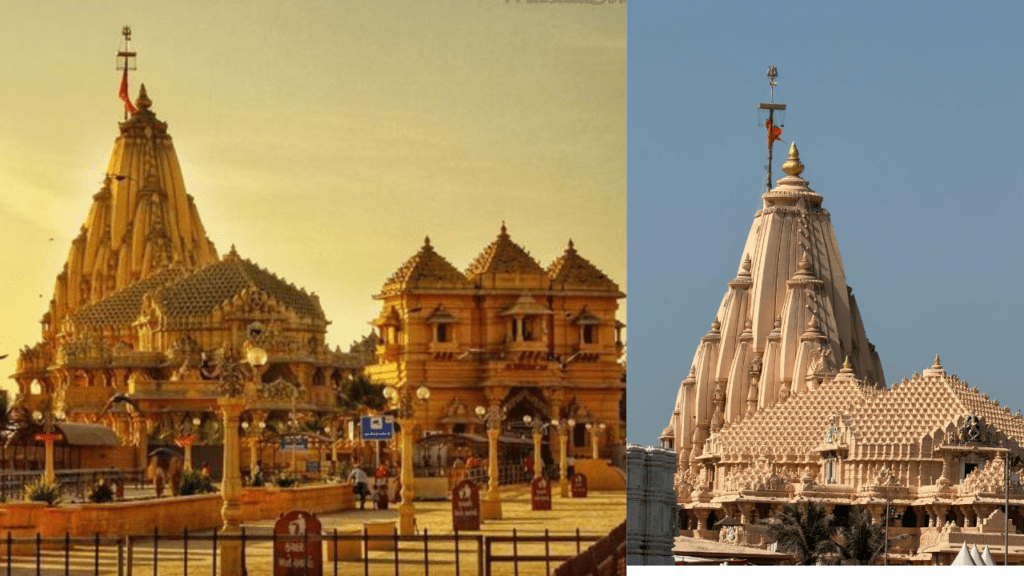
The present Somnath temple follows the Kailash Mahameru Prasad style.
As you enter:
- Large carved pillars greet you
- The main sanctum (Garbhagriha) is modest yet powerful
- The Jyotirlinga is installed in simple dignity
Unlike some temples where photography is heavily restricted around outer zones, Somnath allows photography in outer premises but strictly prohibits it inside the sanctum.
The sea-facing open platform behind the temple is one of the most peaceful spots for meditation.
Many devotees sit there quietly after darshan.
Darshan Experience – What to Expect
On regular weekdays:
- Queue time: 10–20 minutes
- Clean premises
- Organized security
During:
- Shravan Month
- Mahashivaratri
- Kartik Purnima
Crowd levels increase significantly.
Shivaratri at Somnath
Mahashivaratri transforms Somnath completely.
- Extended darshan hours
- Massive chanting
- Continuous abhishekam
- Lakhs of devotees
Dress Code & Devotee Guidelines
Somnath does not impose strict dress restrictions but encourages:
- Modest traditional clothing
- Avoid shorts / sleeveless inside main complex
- Remove footwear before entering
Mobile phones are allowed in outer areas but not near sanctum.
Security checks are thorough yet systematic.
Online Booking & Special Pooja
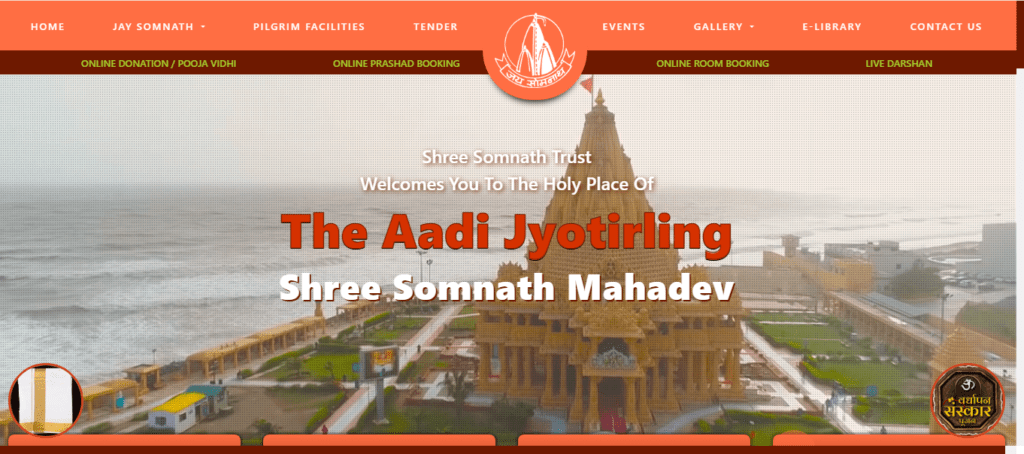
The official website somnath.org allows:
- Special pooja booking
- Donations
- Room bookings
- Prasad booking
General darshan does not require booking.
Avoid third-party websites or social media offers.
Abhishekam at Somnath
Somnath follows traditional Shaiva rituals.
Morning hours are considered ideal for Abhishekam.
Devotees may:
- Offer milk
- Offer bilva leaves
- Participate in special poojas
Complete Shiva Abhishekam Items & Procedure Guide.
Best Time of Day to Visit Somnath
Three powerful time windows:
🌅 Sunrise (6:00–8:00 AM)
Peaceful, less crowd, fresh sea breeze.
🌇 Sunset (6:00–7:30 PM)
Golden temple view against Arabian Sea.
🌙 Night (After 8 PM)
Light & Sound show + illuminated temple.
Each gives a different emotional experience.
Spiritual Atmosphere Compared to Other Jyotirlinga
Every Jyotirlinga has its own energy.
- Kedarnath → Himalayan austerity
- Kashi → Liberation vibration
- Mahakaleshwar → Intense ritual power
Somnath feels like resilience.
Calm. Expansive. Oceanic.
It is less chaotic and more meditative compared to some northern temples.
Veraval to Somnath Distance (Most Searched Query)
One of the most searched travel questions is:
What is the distance from Veraval to Somnath Temple?
- Distance: Approximately 6–7 kilometers
- Travel time: 15–20 minutes by auto or taxi
Veraval Junction (VRL) is the main railway hub serving the region.
From Veraval station, you can:
- Take an auto rickshaw (₹100–₹150 approx.)
- Book a taxi
- Use local buses
The road is smooth and well-connected.
If you arrive late evening, autos are easily available outside the station.
Somnath Nearest Railway Station
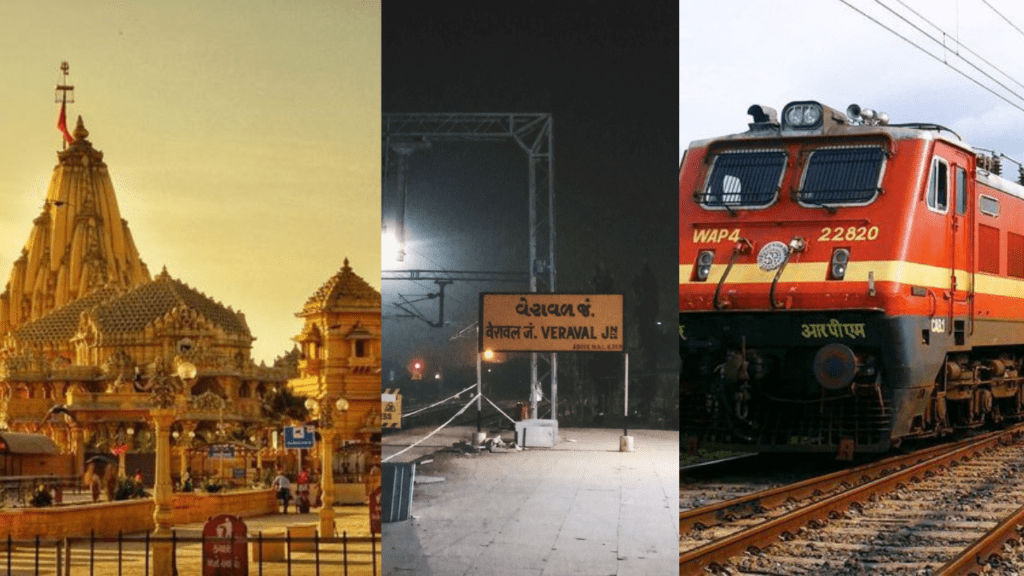
There are two relevant railway stations:
1️⃣ Somnath Railway Station (SMNH)
- Distance: 1–2 km from temple
- Travel time: 5–10 minutes
- Limited train connectivity
2️⃣ Veraval Junction (VRL)
- Distance: 6–7 km
- Major railway hub
- Better connectivity from:
- Ahmedabad
- Rajkot
- Surat
- Mumbai
If you are planning long-distance travel, Veraval is usually the better option.
Nearest Airport to Somnath
The nearest airports are:
- Diu Airport – approx. 85 km
- Rajkot Airport – approx. 190 km
- Ahmedabad Airport – approx. 400 km
From these airports, taxis and buses are available.
Diu is the most convenient if flights align with your schedule.
Distance from Major Indian Cities
Here’s a quick reference distance chart:
| City | Approx Distance to Somnath |
|---|---|
| Delhi | ~1,300 km |
| Mumbai | ~900 km |
| Ahmedabad | ~410 km |
| Hyderabad | ~1,400 km |
| Jaipur | ~1,100 km |
For travelers planning a larger pilgrimage circuit, Gujarat’s rail and road connectivity is strong.
How to Reach Somnath by Road
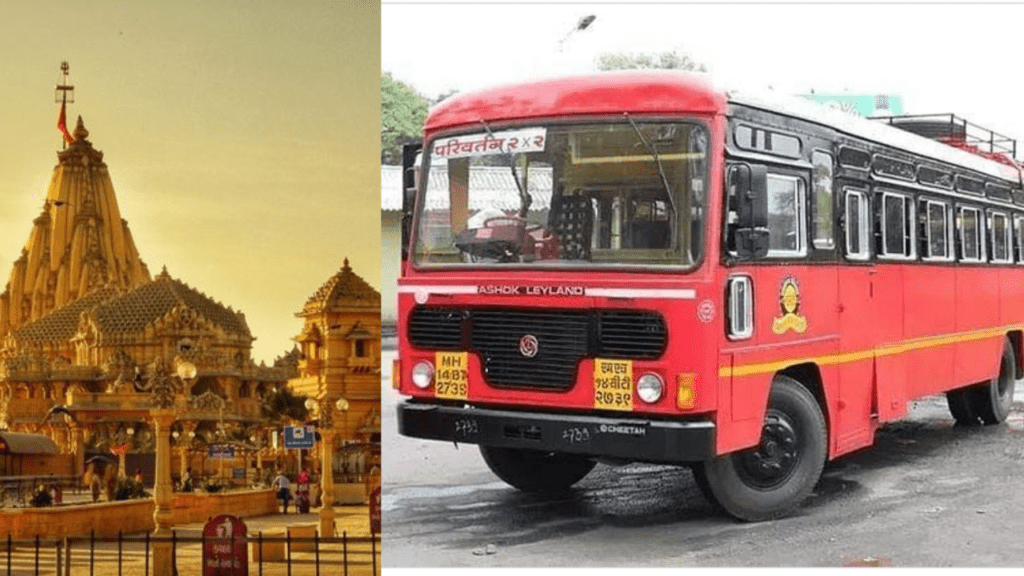
Somnath is well connected by highways.
From Ahmedabad:
- Travel time: 7–8 hours
- Distance: ~410 km
- Route: NH47
From Rajkot:
- Travel time: 4–5 hours
- Distance: ~190 km
From Dwarka:
- Distance: ~230 km
- Many devotees combine Dwarka and Somnath in one trip.
Best Time to Visit Somnath
Somnath can be visited year-round, but the experience varies by season.
October to March (Best Season)
- Pleasant weather
- Ideal for sightseeing
- Comfortable darshan
April to June (Summer)
- Temperature can exceed 40°C
- Afternoon heat is intense
- Early morning darshan recommended
July to September (Monsoon)
- Sea views are dramatic
- Occasional rain may affect light & sound show
Shravan Month
Heavy devotional rush.
Mahashivaratri
Extremely crowded — plan in advance.
1-Day Somnath Itinerary
If you are short on time:
Morning
- Early darshan at 6–7 AM
- Explore temple complex
Late Morning
- Visit Triveni Sangam
- Visit Bhalka Tirth
Evening
- Sunset at temple promenade
- Attend 7 PM aarti
- Watch 8 PM Light & Sound show
2-Day Somnath Itinerary
Day 1
- Temple darshan
- Light & Sound show
Day 2
- Triveni Sangam
- Bhalka Tirth
- Panch Pandav Gufa
- Optional drive to Diu beach
This relaxed itinerary allows proper spiritual experience.
Hotels Near Somnath Temple
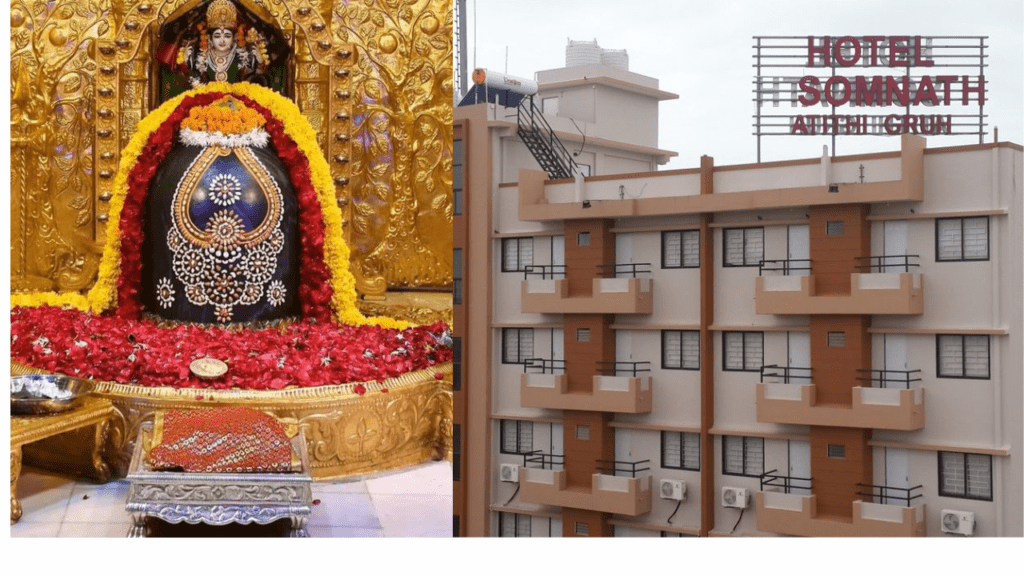
Because of high pilgrimage traffic, Somnath offers:
- Budget dharmashalas
- Mid-range hotels
- Premium sea-facing stays
Most hotels are within 1–2 km radius of the temple.
Peak season booking should be done in advance.
Room rates vary:
- Budget: ₹800–₹1,500
- Mid-range: ₹2,000–₹4,000
- Premium: ₹5,000+
Best Hotels & Stay Options Near Somnath Temple (2026)
| Category | Stay Name | Distance from Temple | Price Range (Approx) | Notes |
|---|---|---|---|---|
| Trust Guest Houses | Sagar Darshan Atithi Gruh | ~600 m | ₹2,000 – ₹4,000+ | Temple trust–managed rooms (AC/Suites) with sea views and pilgrim facilities (Check for Prices) |
| Lilavati Atithi Bhavan | ~1.2 km | ₹750 – ₹1,700+ | Trust guest house (AC/Non-AC) | |
| Maheshwari Samaj Atithi Gruh | ~1 km | ₹750 – ₹1,400+ | Affordable guest house near temple | |
| VIP Atithi Gruh | — | ₹1,300 – ₹1,550+ | Trust guest house with AC options | |
| Tanna Atithi Gruh | — | ₹400 – ₹550+ | Economical option (non-AC) | |
| Budget & Mid-Range Hotels | Hotel Shubh Suvidha | ~1 km | ₹687+ | Basic budget hotel, good for pilgrims (latest prices) |
| Hotel Ambar | ~1 km | ₹739+ | Budget stay near Somnath Railway Station (yatrinivas.com) | |
| Shiv Sagar Hotel | ~1 km | ₹1,485+ | Mid-range property near temple area (Check Availability) | |
| Comfortable Stays | Lords Inn Somnath | ~1.5 km | ₹3,400+ | Highly rated mid-range hotel with amenities (Check Availability) |
| Hotel The Fern Residency | ~2.8 km | ₹2,400+ | Well-rated hotel with good services (Check Availability) | |
| The Bliss Hotel Somnath | ~2.9 km | ₹2,100+ | Comfortable stay with essential amenities (Check Availability) | |
| Hotel the Square | ~2.2 km | ₹1,600+ | Standard hotel with good reviews | |
| Hotel Somnath Sagar | ~2.9 km | ₹2,100+ | Value-for-money option | |
| Premium Hotels | Hotel Sarovar Portico Somnath | ~3.1 km | ₹5,500+ | Premium category hotel with modern comfort |
| Lemon Tree Resort Somnath | ~5.6 km | ₹3,600+ | Resort with pool & modern facilities | |
| Budget Dharamshalas & Guest Houses | Sree Khodiyar Dharmashala | ~0.8 km | ₹899+ | Simple non-AC rooms suitable for pilgrims |
| Maheshwari Athithi Bhavan | ~0.6 km | ₹899+ | Economical guest house near temple | |
| Shyam Guest House | ~Nearby | ₹899+ | Comfortable budget guest house | |
| Various Dharamshalas | ~0.5–1 km | ₹500–₹1,500 | Classic dharamshala options for pilgrims |
Check Availability Hotels and Resorts Near Somnath Temple Click Here
Travel Budget Estimate (Per Person)
Approximate 2-day pilgrimage budget:
- Train (sleeper class): ₹500–₹1,200
- Hotel (1 night): ₹1,500–₹3,000
- Food: ₹500–₹1,000
- Local travel: ₹300–₹800
Total estimated range:
₹3,000 – ₹7,000 depending on comfort level.
Senior Citizen & Family Travel Tips
Somnath is relatively elder-friendly:
- Minimal climbing
- Structured queues
- Clean premises
- Wheelchair accessibility in outer areas
Avoid:
- Peak afternoon heat
- Major festival rush unless prepared
Early morning darshan is ideal for elders.
Safety & Devotee Tips
- Avoid middlemen offering VIP darshan.
- Use only official booking website.
- Carry minimal luggage inside temple.
- Stay hydrated during summer.
Nearby Attractions Around Somnath (Must Visit Places)
Somnath is not just a single temple destination. The surrounding Prabhas region is filled with spiritually significant locations.
Here are the most important ones:
1️⃣ Triveni Sangam (1 km)
This is the sacred confluence of three rivers:
- Hiran
- Kapila
- Saraswati (mythological)
Devotees perform:
- Pind daan rituals
- Holy dip before darshan
- Ancestor offerings
Early morning visits are peaceful and spiritually powerful.
2️⃣ Bhalka Tirth (4–5 km)
This is believed to be the place where Lord Krishna was accidentally struck by an arrow by a hunter named Jara.
A small but serene temple marks the sacred spot.
For pilgrims exploring both Shaiva and Vaishnava traditions, this site holds deep emotional value.
3️⃣ Panch Pandav Gufa (1.5 km)
A cave temple believed to be associated with the Pandavas during their exile.
It offers:
- Small Shiva shrine
- Quiet meditation environment
- Historical curiosity
4️⃣ Suraj Mandir (Sun Temple)
An ancient temple dedicated to the Sun God.
It reflects early architectural elements and is often overlooked by casual visitors.
5️⃣ Somnath Beach & Promenade
The sea-facing area behind the temple is one of the most peaceful stretches in the region.
Watching sunset here after darshan is deeply calming.
Dwarka–Somnath Pilgrimage Circuit
Many devotees combine Somnath with Dwarka.
This creates one of the most powerful pilgrimage circuits in western India.
Distance Between Somnath & Dwarka
Approximately 230 km
Travel time: 4–5 hours by road
Suggested 3–4 Day Pilgrimage Plan
Day 1:
Arrive Somnath
Evening Aarti + Light & Sound Show
Day 2:
Triveni Sangam
Bhalka Tirth
Drive to Dwarka
Day 3:
Dwarkadhish Temple
Nageshwar Jyotirlinga
Bet Dwarka
This circuit beautifully blends:
- Shaivism (Somnath)
- Vaishnavism (Dwarka)
- Another Jyotirlinga (Nageshwar)
Unique Facts About Somnath Jyotirlinga
Here are some lesser-known but fascinating facts:
🔹 1. Arrow Pillar (Baan Stambh)
A pillar inside the temple complex indicates that there is no landmass between Somnath and Antarctica in a straight line southward.
🔹 2. Seven Reconstructions
Somnath is believed to have been rebuilt at least seven times.
🔹 3. Sea-Facing Sanctity
Very few major Jyotirlinga temples directly face the ocean.
🔹 4. Post-Independence Symbol
The reconstruction after 1947 was not just religious — it symbolized cultural restoration.
🔹 5. Most Accessible Jyotirlinga
Compared to Kedarnath or Bhimashankar, Somnath is one of the easiest Jyotirlingas to visit logistically.
Frequently Asked Questions
Somnath is traditionally listed first among the 12 Jyotirlingas. According to mythology, the Moon God (Chandra) installed the first Jyotirlinga here after being freed from Daksha’s curse by Lord Shiva.
The temple is open daily from 6:00 AM to 10:00 PM. Aartis are performed at 7:00 AM, 12:00 PM, and 7:00 PM.
The distance from Veraval Junction to Somnath Temple is approximately 6–7 km, taking around 15–20 minutes by auto or taxi.
Yes. Special pooja booking and accommodation booking are available through the official website somnath.org. General darshan does not require prior booking.
October to March is the most comfortable season. Mahashivaratri and Shravan month attract heavy crowds.
Yes, entry for general darshan is completely free. The Light & Sound show has a nominal ticket fee.
Final Conclusion
Somnath is not merely a temple on the coast of Gujarat.
It is a story of devotion surviving invasion.
It is faith rebuilt in stone.
It is the Moon regaining light.
It is India’s spiritual resilience standing against centuries.
Whether you visit for:
- Spiritual awakening
- Jyotirlinga yatra
- Cultural exploration
- Or peaceful sea-facing meditation
Somnath leaves a lasting impression.
If your journey through the 12 Jyotirlingas begins anywhere, let it begin here — where light first manifested.
Engagement Close
Are you planning your Somnath pilgrimage soon?
Save this guide.
Share it with fellow devotees.
And continue exploring the remaining Jyotirlinga temples to complete your sacred yatra.